
NNEDV Applauds Introduction of the Family Violence Prevention and Services Improvement Act (FVPSA)
July 25, 2019
FOR IMMEDIATE RELEASE
Contact: NNEDV Communications Team (Communications@NNEDV.org)
Washington, DC – The National Network to End Domestic Violence (NNEDV) applauds the introduction of the Family Violence Prevention and Services Improvement Act of 2019, a critical FVPSA reauthorization bill for local domestic violence shelters and programs, state coalitions, tribes and tribal coalitions, U.S. territories, and culturally specific programs to provide emergency shelter, counseling, legal assistance, children’s services, crisis intervention, and domestic violence prevention.
Introduced by Senators Bob Casey (D-PA) and Lisa Murkowski (R-AK), the bipartisan bill would reauthorize critical funding for domestic violence shelters to keep the lights on and doors open to serve the more than 1.3 million victims and their children every year, and expand access to more communities.
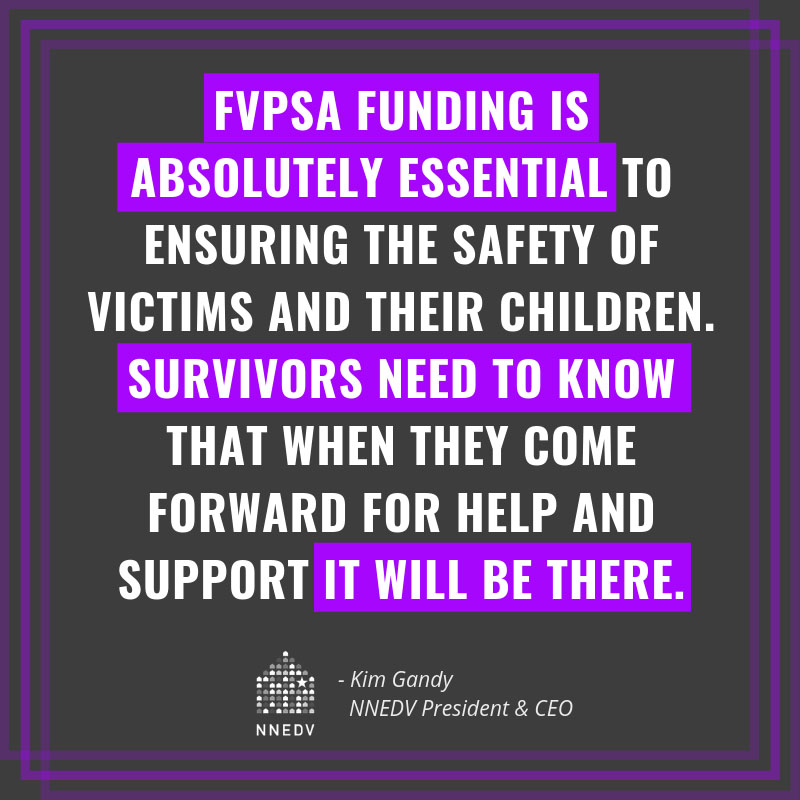
Domestic violence shelters provide lifesaving options to victims and their children fleeing abuse. Yet they often operate on razor-thin budgets. “FVPSA funding is absolutely essential to ensuring the safety of victims and their children,” said Kim Gandy, NNEDV President & CEO. “Survivors need to know that when they come forward for help and support, it will be there.”
Domestic violence program shelters report that they struggle to meet the demand for these critical services. NNEDV’s 13th Annual Domestic Violence Counts Census Report found that 74,823 victims were served in one 24-hour period. Unfortunately, on that same day, over 9,000 victims made requests for services that could not be provided because programs lacked the resources to meet victims’ needs.
“Due to shelter capacity, we had to turn away a victim from a neighboring state. She cried and begged for a corner of a room for her and her child to sleep in,” one New Hampshire advocate reported.
Additionally, many communities have limited or no access to FVPSA’s funds, leaving victims without options to escape abuse. Similarly, prevention funding is incredibly limited, undermining our nation’s efforts to stop violence before it begins. The Casey/Murkowski bill, S.2259, expands access to FVPSA’s resources through policy enhancements and increased funding authorization.
“NNEDV commends Senator Casey and Senator Murkowski on their strong leadership and commitment to preventing violence and addressing the current needs of survivors,” said Gandy. “We look forward to the passage of this critical piece of legislation.”
In addition to funding for local domestic violence shelters and programs, FVPSA allocates funding for state and territorial domestic violence coalitions to advance safety and justice for survivors in their states; for tribal governments to provide essential services to American Indian and Alaska Native survivors; and for DELTA Prevention Grants to stop abuse before it starts.
“Advocates call on Congress to pass this bill and to significantly increase annual appropriations to ensure that domestic violence shelters can help every victim seeking freedom from abuse, and provide safety to them and their children,” said Gandy.
###
The National Network to End Domestic Violence (NNEDV) represents the 56 state and U.S. territorial coalitions against domestic violence. NNEDV is a social change organization working to create a social, political, and economic environment in which domestic violence no longer exists. NNEDV works to make domestic violence a national priority, change the way society responds to domestic violence, and strengthen domestic violence advocacy at every level.