

Recognizing and Combating Technology-Facilitated Abuse
October 13, 2016
In addition to Domestic Violence Awareness Month, the National Network to End Domestic Violence (NNEDV) also recognizes October as National Cyber Security Awareness Month.
Online Harassment is Abuse
One misconception about technology-facilitated abuse is that online harassment is not “real” abuse, or that the harassment or threats someone receives online may not be credible or as scary. Yet, not only can online threats be extremely terrifying, but much of this abuse is often tied to offline behaviors, including stalking and assault.
Victims’ experiences are often minimized as they are told to just “get offline,” “change their number,” or “log off.” When so many of us live and work online, disconnecting is not a sustainable solution.
We instead focus on educating survivors on helpful safety planning strategies, including creating strong passwords, locking down their accounts, and documenting instances of abuse and harassment. However, for there to be true cybersecurity for victims of violence, we must work to stop the abusive and harmful behaviors and tactics that are often perpetrated online.
Technology-facilitated abuse is a serious issue that does not always remain online and could escalate to other forms of violence. The presence of technology in our lives today is also vastly different than 50 years ago. How we look for employment, stay connected to friends and family, or even use transportation all require some interaction with technology.
Studies show that 74% of adults who are online use a social networking site, and 81% of adult cell phone owners send and receive text messages. Technology can give victims access to important resources and services and allow them to stay connected to their loved ones and other support systems.
While safety planning provides important steps to give control back to survivors, creating safe online environments should also be a priority of advocates, service providers, technologists, and law enforcement.
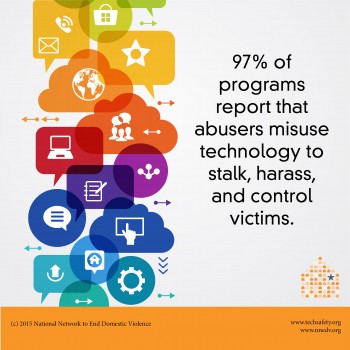
In a survey conducted by NNEDV:
- 97% of domestic violence programs reported that abusers use technology to stalk, harass, and control victims.
- Nearly 80% of programs reported that abusers monitor survivors’ social media accounts.
- 86% reported that victims are harassed through social media.
One in four stalking victims report cyberstalking, which includes receiving unwanted emails, text messaging, and social media surveillance and/or harassment. All of these behaviors — harassing, monitoring, and unwanted calls and text messages — create a pattern of stalking and abusive tactics that aims to control the victim and further instill fear.
Technology is Not the Problem
It’s important to recognize that technology is not the enemy. Asking a survivor to log off, press delete, or not use social media will not stop the abuse from happening. If we really want to increase cybersecurity, we must hold bad actors accountable for their actions. This means that we must address the sharing of nonconsensual personal images, take threats and harassment seriously, and call out rape culture that is tweeted, texted, or shared.
While there are some limitations to monitoring technology-facilitated abuse and proving who is behind abuse, there has been tremendous effort in creating policies around privacy, victim confidentiality, and technology safety.
NNEDV’s Safety Net Project is dedicated to looking at the intersection of technology and intimate partner violence and addresses how technology impacts the safety, privacy, accessibility, and civil rights of victims. In addition to training, education, and advocacy, Safety Net offers a host of resources and tip sheets for survivors and agencies working with survivors.
Get Involved
- Visit TechSafety.org to learn more about technology, privacy, and safety as it relates to survivors of abuse and the programs that serve them.
- This month, we are challenging widely-held perceptions about domestic violence using the hashtag #31n31 – and this week, we are focusing on technology safety-related misconceptions. (See the entire campaign on Pinterest.)
- Learn more about Cyber Security Awareness month and other ways you can be involved at Stay Safe Online.