
Safe Voting Tips for Survivors
Domestic violence victims and survivors deserve to participate safely in all aspects of our country’s political process (including voting) without fearing further violence from an abuser.
It’s also essential for victims and survivors to be aware of the ways their voter information is collected and used to help them make informed decisions about their safety.
It’s never your fault if someone chooses to make you feel unsafe or afraid for exercising your right to vote. Some victims and survivors may find it helpful to create a safety plan around voting if they suspect an abuser may choose to do this.
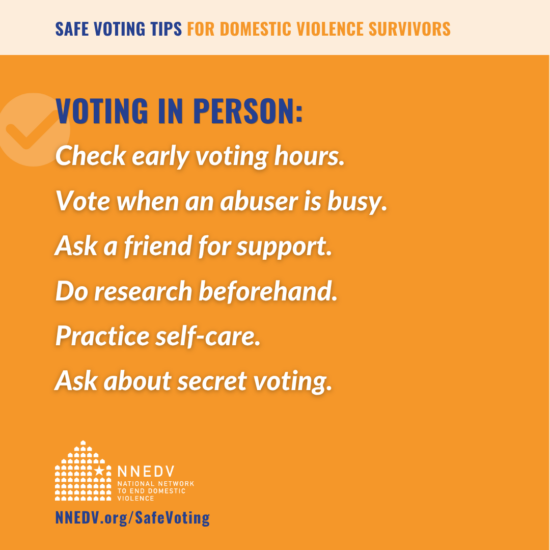
Voting in Person
Everyone’s safety plan looks a little bit different. A voting safety plan might include some of the following elements, depending on what you decide is best:
Check early voting hours. Many states offer days or weeks of early voting before Election Day. This may offer you more flexibility for when you can vote safely.
Vote during a time when an abuser is busy. If you’re worried about being joined by, or running into, an abuser at your polling place, you can think about the abuser’s schedule and try to pick a time when they may be busy.
Ask a friend for support. Even if a friend (or family member, or other trusted person) can’t be with you in person, maybe they can stay in touch via text. Do you know a neighbor who’s voting in person? Maybe they’re willing to head to the polling place together.
Do research beforehand and vote quickly. Planning how to vote can save time at the polling place, especially if you’re worried about seeing an abuser.
Practice self-care before and after voting. Planning a fun or relaxing activity before or after voting can help minimize stress. Do you have a favorite grounding activity? Practice it while waiting in line.
Ask a poll worker about secret voting. If you’re voting with an abuser and worry they may force your vote, ask a poll worker about casting a secret ballot, if it’s safe for you to do so.
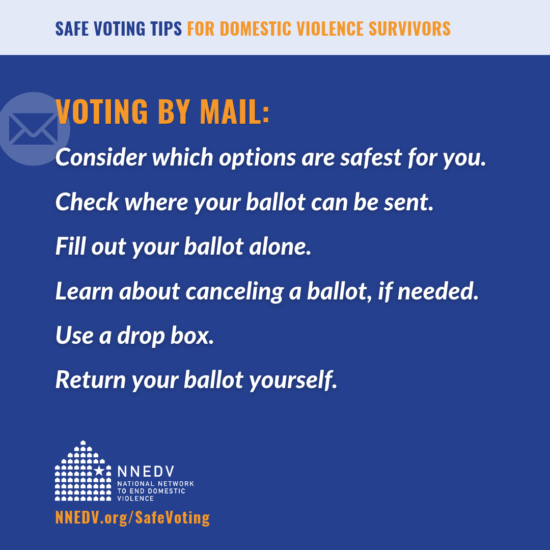
Voting by Mail
Consider vote-by-mail options. Voting by mail has become more common. In fact, there are some states that universally vote by mail, like California and Washington.
All states offer some form of absentee or mail voting, with different requirements in each state. This can be especially helpful for survivors who have safety concerns about seeing an abuser at their polling place, or whose schedules don’t allow them to vote on Election Day.
On the other hand, voting by mail may create issues if you live with an abuser who might want to interfere with your right to vote. This is why making a safety plan for voting by mail can also be important:
Consider whether you would prefer to vote in person. States that allow vote-by-mail generally still do have in-person options. If you think it would be safer to vote away from where an abuser lives, you can look up your polling place and make a plan to go when you can do so on your own. Depending on your state, there may be early voting options in addition to Election Day hours. Make sure to check your state’s rules for whether you need to bring your unused mail ballot with you to dispose of it properly with the election workers.
Check your state’s rules about where your ballot may be sent. If your state can send your ballot somewhere other than a shared mailbox, consider doing that to prevent anyone else from taking your ballot from you. Some states may also allow you to pick up a ballot from the Board of Elections or another location.
Fill out your ballot when the abuser is not at home. If possible, voting when an abuser is not home or nearby may be the best way to ensure the secrecy and security of your ballot.
Check your state’s rules about canceling a ballot. If an abuser takes your ballot to fraudulently submit it themselves, or forces you to fill it out the way they want, it might be possible to later cancel or “spoil” the ballot and vote in person instead. This varies by state. Check your local rules to understand your options for ensuring that it is your vote that is counted.
Use a drop box. Many states set up locations where voters can directly return a mail ballot rather than having to go through the post office, where a ballot might be delayed or lost. This might be at your physical polling place, a Board of Elections office, or somewhere else. Some states and cities list drop box locations online. Try using a search engine (like Google or Bing) to search “find ballot drop box” and your state. If you are going to mail your ballot, make sure you understand the deadlines for it to be postmarked or received. These can vary greatly by state.
Return your ballot yourself. If possible, do not allow anyone else to mail or drop off your ballot. It may be illegal in some states, or restricted to people who are disabled or have another legally valid reason. If someone insists on returning your ballot for you, check whether your state law allows this and whether there is any other way for you to safely vote instead.
Learn more about voting by mail and absentee voting in Voting & Survivor Privacy from NNEDV’s Safety Net team.

Availability of Voter Registration Information
Depending on a survivor’s state or territory, their voter registration records may be considered public records. This may include information like names and home addresses. This can be especially concerning for survivors who are concerned an abuser would use this information in order to find, stalk, or further harm them.
All states allow some form of access to voter registration records. However, several states allow personal information to be withheld if it’s specifically designated as confidential, and many states have Address Confidentiality Programs (ACPs) to provide some privacy and protection of voter records. Learn more about Address Confidentiality Programs from NNEDV’s Safety Net team.
Online and automatic voter registration are becoming more popular. These systems can provide more accessibility for survivors and reduce barriers to participating. However, abusers may also find ways to misuse them. Find more information in Voting & Survivor Privacy from NNEDV’s Safety Net team.
Every survivor deserves to choose what may or may not be helpful and appropriate for them when participating in the political process — and every survivor deserves for that process to be safe, private, and trauma-informed.